

How Festivals Are Reengineering Connectivity
How Festivals Are Reengineering Connectivity for Attendees and Vendors
Music, food, and arts festivals have become high-tech operations. From wristband scanning to live streaming stages, cloud-based ticketing, and vendor point-of-sale systems, reliable internet is no longer a luxury—it is infrastructure. Yet festival organizers consistently face a major challenge: the public internet and venue WiFi infrastructure often cannot handle the intense, transient demand.
For festival network engineers, temporary connectivity introduces a unique set of design constraints, particularly in high-density, outdoor settings. Unlike corporate offices or permanent venues, festival grounds change constantly, with tens of thousands of mobile devices and fluctuating environmental conditions impacting the signal.
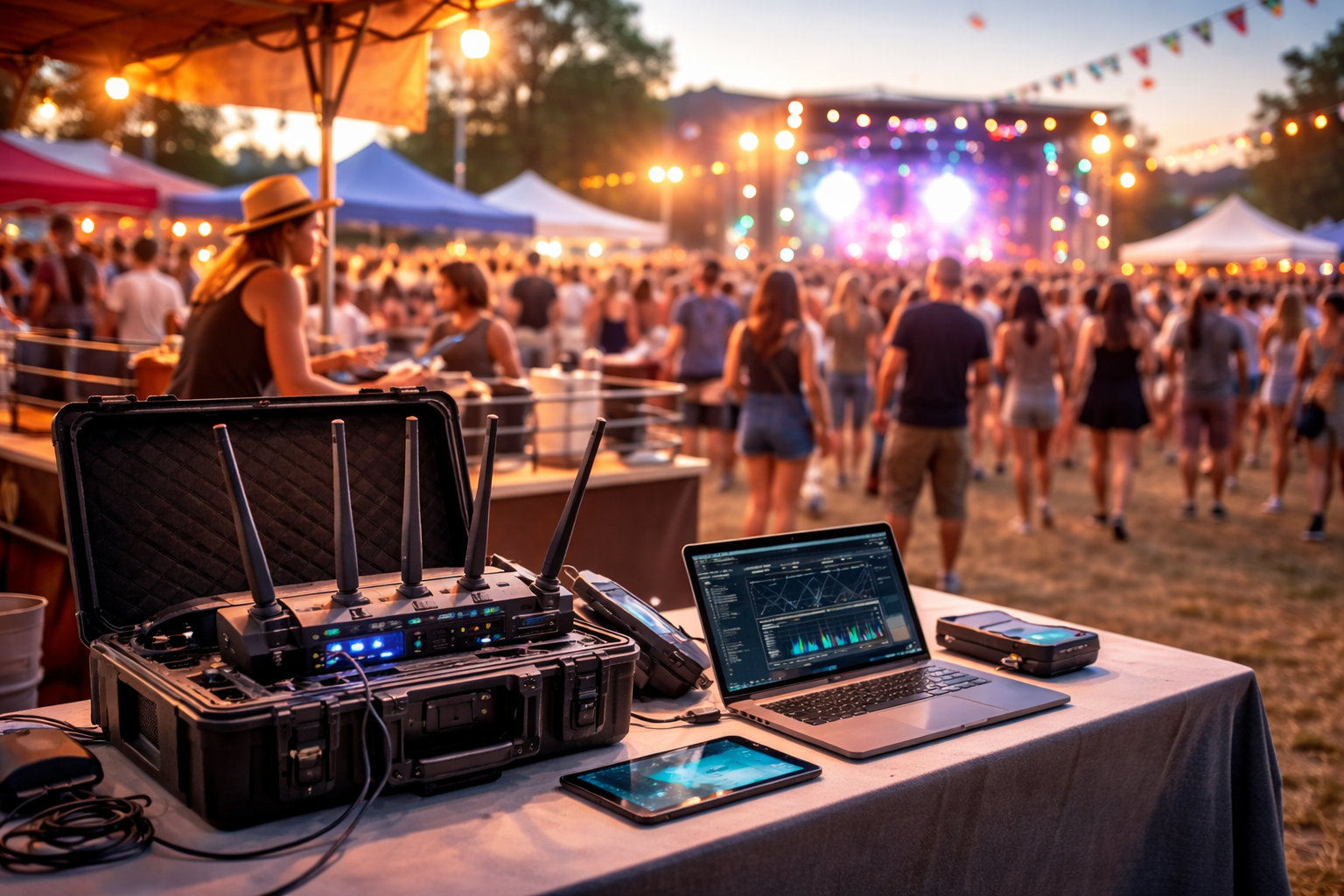
The Technical Challenge of Outdoor Event Networks
Traditional WiFi access points are designed for enclosed spaces, with predictable RF reflections and cabling. Open-air festival sites introduce:
- Unstable RF propagation: Trees, tents, stages, and sound equipment block or scatter signals.
- High client density: Attendees congregate near main stages, often exceeding AP design limits.
- Interference from multiple sources: Other events, radio equipment, and personal hotspots create unpredictable noise.
- Bandwidth spikes: Streaming live video, uploading photos, and POS systems simultaneously increase throughput requirements.
According to a 2024 report from Parks Associates, over 90% of festival attendees expect fast and stable internet access on-site, with live social media sharing and app-based experiences as primary drivers. At a festival with 25,000 visitors, that could equate to roughly 60,000–70,000 active devices needing concurrent access.
Why Festival WiFi Fails Without Proper Planning
Organizers who rely solely on public networks or general venue WiFi often see the following issues:
- Slow upload speeds: Critical for live social feeds, ticket scanning, and streaming.
- Frequent disconnections: Device roaming can drop users between access points.
- Security vulnerabilities: Open networks allow rogue devices and increase exposure to cyber threats.
- Limited support: Venue IT teams are not always equipped for temporary outdoor networks with high variance in load.
A network architect who specializes in large-scale events stated in an interview:
“Festival networks are like storm systems: they evolve minute by minute. Without adaptive infrastructure, performance degrades quickly.”
Festival-Specific Internet Demands
Different festival stakeholders rely on connectivity in different ways:
- Vendors: Require reliable WiFi for POS terminals, inventory tracking, and digital menus. Slow connectivity can directly affect revenue.
- Organizers: Need dashboards to monitor ticketing, staffing, and emergency alerts.
- Attendees: Expect seamless access to festival apps, mobile payment services, and streaming feeds.
- Media: Journalists and live streamers require high upload speeds to distribute content in real time.
Tech-heavy festivals, particularly electronic music and interactive art festivals, often push networking requirements beyond what temporary LTE hotspots can provide without careful configuration.
Portable Solutions as a Festival Backbone
Enter TradeShowInternet’s festival WiFi solutions—portable, pre-configured internet kits designed for high-density outdoor events. By relying on bonded cellular networks with multi-carrier failover, these systems can:
- Maintain consistent throughput under heavy load
- Provide both wired and wireless connections for vendors and staff
- Create isolated networks to protect sensitive transactions
- Be deployed quickly, often without specialized on-site IT
From a technical perspective, these systems effectively act as mobile network nodes with local traffic control, offloading strain from venue infrastructure and improving reliability for critical applications.
Bandwidth Management and Network Design Considerations
Festival network engineers adopt several strategies to optimize performance:
- Segmentation: Separate attendee WiFi from operational networks to prevent cross-traffic interference.
- Dynamic load balancing: Direct devices to different APs or carriers to prevent congestion at peak times.
- Monitoring dashboards: Track real-time network usage and identify bottlenecks before they affect users.
- Redundant carriers: Bond multiple 5G or LTE providers to maintain uptime if one network underperforms.
Data from the GSMA shows that temporary cellular deployments at large outdoor festivals can achieve 10–15 Mbps per device for enterprise-grade clients, with multi-carrier systems improving reliability for business-critical traffic.
Case Example: A 50,000-Person Music Festival
Consider a music festival hosting 50,000 attendees, 500 vendors, and multiple media outlets. Without dedicated portable infrastructure:
- Venue WiFi would likely be oversubscribed within hours.
- POS terminals could intermittently fail, causing long vendor queues.
- Media uplinks might stall, preventing live social feeds from reaching audiences.
Deploying portable solutions, like TradeShowInternet’s festival WiFi solutions, allows organizers to isolate vendor and media traffic while ensuring attendees still enjoy app-based services. The network becomes predictable, measurable, and easier to troubleshoot during the event.
Security and Compliance Implications
Outdoor festivals frequently handle sensitive data such as credit card information, personally identifiable information (PII), and employee records. Public networks are vulnerable:
- Rogue access points
- Data sniffing on unencrypted networks
- WiFi misconfiguration leading to exposure of internal systems
Portable systems enable IT teams to apply firewalls, private VLANs, and enterprise-grade encryption protocols, aligning with PCI DSS and other compliance standards. This approach is essential for festivals with high transaction volumes or international vendors.
Operational Benefits for Organizers
Beyond connectivity, portable internet kits provide operational flexibility:
- Scalable deployment: Units can be added or removed depending on expected attendance or vendor requirements.
- Mobility: Kits can move between stages, VIP areas, and temporary command centers.
- Cost predictability: Fixed rental rates prevent unexpected venue fees or bandwidth surcharges.
- Minimal setup time: Often under one hour per deployment, reducing labor costs and logistical headaches.
These features are particularly relevant for multi-day festivals or those spread across large geographic areas.
Emerging Trends in Festival Connectivity
Networking professionals observe several ongoing developments:
- IoT integration: Connected wristbands, sensor arrays, and interactive exhibits create additional traffic demands.
- AR/VR applications: Live immersive experiences require high-throughput, low-latency connections.
- Real-time analytics: Organizers increasingly monitor attendee movement, vendor performance, and environmental conditions in near real time.
- Hybrid event models: Festivals are expanding online with live streaming, requiring robust uplinks from the field.
Portable, carrier-bonded solutions provide the necessary backbone for these innovations while maintaining predictable performance.